Cottonwood Crossing Summer Institute (CCSI) is an outdoor field studies program for high school students that takes place at Cottonwood Canyon State Park along the John Day River. Begun in 2015, the program was initially incubated by the Oregon Parks and Recreation Department and Oregon Parks Forever (f/k/a Oregon State Parks Foundation). It is coordinated through Eastern Oregon University (EOU) and allows students to earn early college credit. Oregon Parks Forever raised the funds to build an “Experience Center” to serve as a classroom for this and other programs.
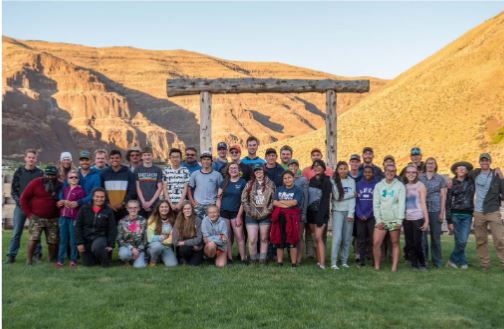
Participants choose from five course options where they learn about locally significant cultural or natural resources. Projects are led by EOU faculty, EOU Capstone students, and other regional professionals. The camp takes place along the John Day River between Sherman and Gilliam counties at Cottonwood Canyon State Park. Students camp in tents, prepare group meals in an outdoor kitchen, and utilize both a state-of-the-art educational facility and the surrounding landscape as their classroom. Projects vary from year to year with topics focused on local natural resources, human performance in the outdoors, creative writing, and renewable energy applications.
While the CCSI program was initially envisioned to serve students and teachers living within the John Day Watershed, participants have been coming from counties across the state including members of the Umatilla and Grande Ronde Tribes.
To contribute to the Scholarship fund, please complete this form: https://igfn.us/form/q4u0TA
Why is a scholarship fund needed?
Since taking full responsibility for CCSI in 2018, EOU has been subsidizing the program cost. They now need to increase the tuition to cover these costs but are concerned that this change could eliminate access for low-income students. Accordingly, Oregon Parks Forever has been asked to build and administer a scholarship fund to enable low-income students to participate.
What is the goal of CCSI?
The goal of CCSI is to serve high school students and high school teachers with outdoor education opportunities that enhance their natural resource literacy and apply their learning to authentic projects. CCSI was founded around the central idea of cultivating a sense of place in rural communities by using the watershed as the context for students and teachers to participate in authentic outcomes-based learning outside the classroom. There are specific objectives for each of the three audiences served through CCSI: offer students the chance to work on high-quality, long-term projects that deepen their knowledge and understanding of real issues in their watershed and community; offer professional development opportunities for teachers and begin to form a rural network of K-12 teachers dedicated to developing and integrating authentic outdoor learning experiences into their classrooms using the local watershed; and to build community connections and interest in rural sustainability and natural resources through place-based education.
Place-based education boosts student engagement and academic achievement and forges connections within the community by allowing students to make tangible contributions to real community problems. Projects are rooted in relevant community issues and connected to Oregon career pathways. The courses integrate grade level content standards and develop inquiry-based lessons that can also be implemented in the classroom by participating teachers.
Why is this project important?
Many rural youth are exposed to a more limited view of career options than their urban and suburban peers. Rural economies do not support the variety of careers that exist and that students can aspire to achieve. It is an objective of CCSI to expose students to a broader view of what is possible for their futures and to inspire them to continue their education after high school if their goals require it. Likewise, urban youth often do not have exposure to rural life and rural peers. Our hope is that by joining rural and urban youth for a week-long educational program, we can make a small dent in the urban/rural divide.
While rural living is often seen by the general population as synonymous with a healthy lifestyle, the numbers tell a different story. Rates of cancer deaths are higher in some of our rural communities and the increased risk has been associated with behaviors including physical inactivity. Rural adolescents have also been shown to consume less fruit and are more likely to be overweight than their peers. CCSI exposes youth to outdoor adventure and life skills that can be transformative.
As a group, students in eastern Oregon perform about 5% below the Oregon average on their math scores for standardized tests. In addition, teachers in rural schools tend to be isolated from their peers. They often teach several subjects and may be the only teacher of a particular content area at their school. CCSI is building a Professional Learning Community for teachers around the concept of place-based learning which integrates math and science content into authentic real-world applications.
CCSI aspires to encourage and equip future generations of Oregonians to live the life they dream of and to understand, value and be good stewards of our region’s public lands. CCSI extends classrooms into the outdoors and connects students with the natural environment while supporting the achievement of the Oregon Environmental Literacy Plan.
Expected Outcomes of this Project
Students who participate in CCSI are expected to:
- Increase academic achievement and engagement in school
- Increase understanding and engagement with natural resource and community issues
- Enhance understanding about future natural resources career options
Teachers who participate in CCSI are expected to:
- Increase their knowledge and skills related to the watershed
- Increase knowledge and use of inquiry-based lessons
- Increase pedagogical knowledge and use of experiential place-based teaching methods
These outcomes are expected based on:
- Implementation of place-based and inquiry-based learning at the summer institute and in the classroom
- Use of best practices in professional development including active learning and modeling teaching methods
- Sustained collaboration among teachers through the PLC